How Do You Build a Vocabulary System That Actually Works?
You do not need 5,000 words — you need 300 words you genuinely own. Here is a second-brain system that builds speaking fluency, not just recognition.
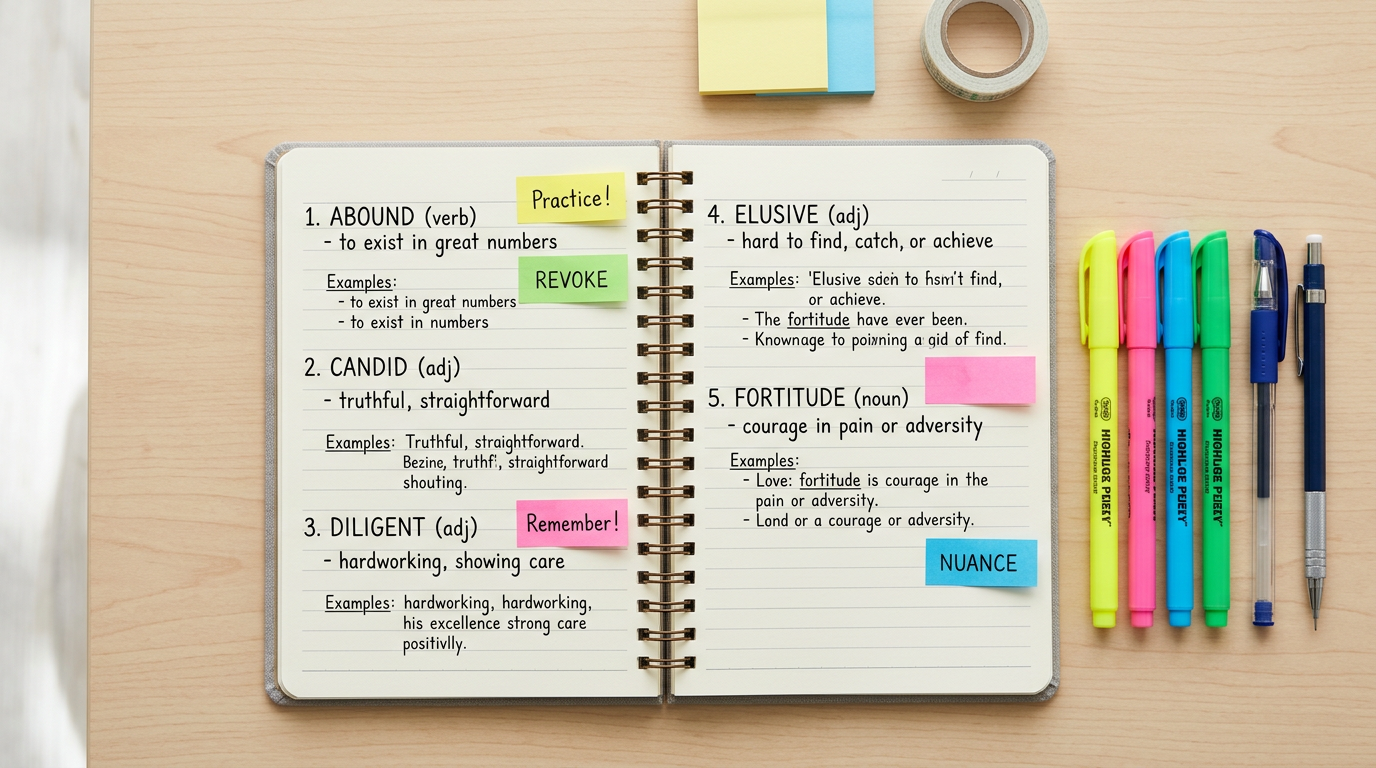
How do you build a vocabulary system that actually works? You do not need 5,000 words — you need 300 words you genuinely own. A system built around words you have actually used in real conversation builds fluency far faster than any app-based word list.
Why do vocabulary apps not build speaking fluency?
Vocabulary apps train recognition memory — seeing a word and knowing its meaning. Speaking requires production memory — retrieving and using the word under pressure. Recognition practice does not train production. This is why learners with 3,000 app-learned words still freeze in real conversations.
What is the English second-brain vocabulary system?
Principle 1: Only track words you have actually used
Every word in your system must be one you have spoken or written in a real context. This filter eliminates 90% of traditional vocabulary study.
Principle 2: Track the context, not just the definition
Record the actual sentence you used the word in — not a dictionary example. Your brain encodes it alongside the real memory of using it.
Principle 3: Aim for 300 owned words, not 3,000 recognised ones
How do you add words to the system?
Notice a word you wish you could use naturally. Use it once in your next speaking or writing session. Record the word and the sentence you used it in. Review your list once a week for five minutes.
If you could not use it naturally, it does not go in the system.
What words should you target first?
For IELTS: discourse markers and opinion phrases ("What strikes me is...", "The evidence suggests..."). For workplace English: the precise vocabulary of your specific field. For general fluency: the words for ordinary daily experiences and emotions.
Three hundred words you own will take you further than three thousand you recognise. Start building the right kind of vocabulary today.